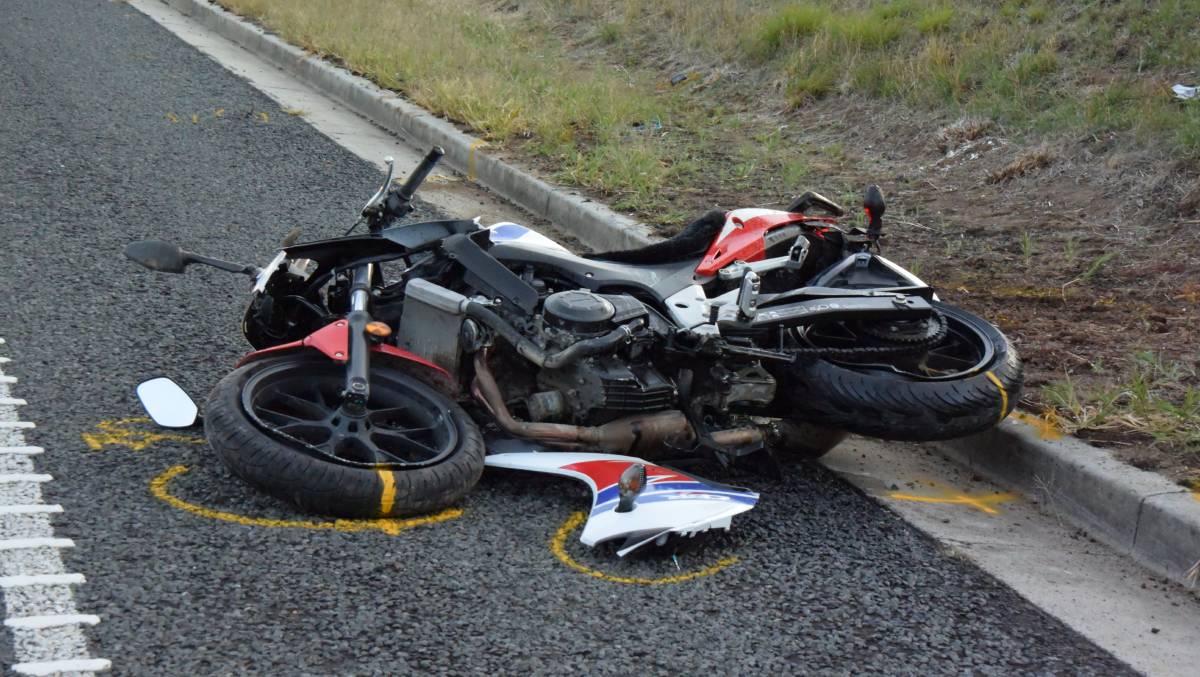
These impacts can be categorized as follows:
- Frontal impact: the motorcycle tilts around the axis of the front wheel, and the rider hits the handlebars with the head, thorax, abdomen, or pelvis. Possible femoral fractures if the feet get stuck on the toe clips.
- Transverse impact: the rider is crushed between the motorcycle and the object struck. The shock causes damage to the limbs and abdomen.
- Ejection: the motorcyclist continues his trajectory until his head, arms, chest, abdomen, or legs strike the ground, a vehicle, or a safety rail. Lesions are observed at the point of impact, but also in the rest of the body (transfer of kinetic energy). In this situation, the risk of serious injuries is very high, the rider being hardly protected.
Statistically, here is how the injuries are distributed among motorcycle drivers surviving a road accident (percentage reported for each anatomical region to the number of victims concerned) :
Lower limbs: 65%
Upper limbs: 50%
Skull / face: 18.5%
Skin surface: 10%
Thorax: 9%
Spine: 7%
Abdomen: 5.5%
Neck: 4%
The total of this distribution exceeds 100% since it is not uncommon for the same victim to have several lesions.
It is the youngest of us who are most affected by motorcycle accidents. Inexperience mixed with the ardor of the first kilometers does not mix well. Thus, fatal motorcycle accidents mainly occur among 18/34-year-olds.
In 65% of fatal accidents, they take place outside built-up areas (including 6% on motorways and more than 50% in a curve)
Injuries causing death are mainly the consequences of shocks to the head (54%) and the torso/back (38%).
Despite everything, in 2017, 21 motorcyclists killed (including two passengers) were not wearing helmets—a worrying finding. Even if they lack equipment is not a direct cause of fatal motorcycle accidents, it is indeed an aggravating factor.
One of the most recurring injuries is undoubtedly the scaphoid fracture of the wrist. This bone is one of the eight carps that make up the wrist. This fracture is caused by hyperextension of the wrist. And you will know the broken bone healing burning sensation.
The collarbone is also a particularly fragile area. When impacted on the shoulder, the pressure exerted can break this bone, which connects the sternum to the scapula. The risk is all the more important when the helmet abuts against the collarbone. This type of fracture is very common on all terrain and on the track, which is why track airbag systems are primarily aimed at protecting this region of the body.
The cervical spine area (neck) is particularly exposed, in particular, because of the lack of equipment. Protecting this area is not easy because neck mobility is very important on a motorcycle. In addition, between the helmet and the back protector, the entire area is open to shocks. This part being very mobile, any impact can cause a violent movement of the head and cause cervical lesions. The damage can range from a simple sprain without a neurological disorder to complete paralysis.
THE RISK OF BURNS
Light cotton clothing such as t-shirts, shorts, and classic jeans should be avoided on a motorcycle because they do not offer sufficient abrasion resistance in the event of a slip. The lack of protection can lead to second-degree burns caused by the skin rubbing against the asphalt. Slips are very frequent during falls on a 2-wheeler, so it is essential to be properly equipped to protect yourself from these injuries.
Gloves, jackets, pants, boots, and helmets are essential!
Update on the different degrees of burn:
- 1st degree: the epidermis is shiny and red with no blisters and discomfort. Normally this sort of burn cures in a week. The cycle can be improved using humidifiers.
- 2nd degree: This type of burn is characterized by the appearance of blisters following the destruction of the epidermis. 2nd-degree burns can be “superficial” or “deep” when the dermis is affected. The superficial 2nd degree resolves on its own over time while the deep 2nd degree requires a skin graft.
- 3rd degree: The most serious level of burn where the entire dermis and epidermis are destroyed. Skin grafting is then essential because healing is impossible. The skin is brown, and the affected area is insensitive.
INJURIES ARE NOT THE SAME ACCORDING TO PRACTICE
Motorcycle accidents cause different injuries depending on whether they occur on the road, on the track, or off-road.
On track or circuit, accidents often result from loss of control of the vehicle. The injuries are mainly related to slips and the lesions less important because of the absence of obstacles.
In off-road, accidents cause more injuries related to the impact (fractures, dislocations, sprains) to the slide. In rally or enduro, pilots encounter many obstacles such as trees, rocks, holes … In cross country, we must also take into account the jumps, which add a vertical dimension to falls. Thus, the equipment is very different and takes into account the specificities of the offroad.
On the road, all the factors are combined because of the multiple obstacles present: barriers, side rails, asphalt, other users, pedestrians, manhole covers, white lines, sidewalks, potholes, speed bumps, speed. The diversity of dangers implies having to equip yourself effectively against abrasion and impact.
 The Digital Hub